University of Tennessee Athletics
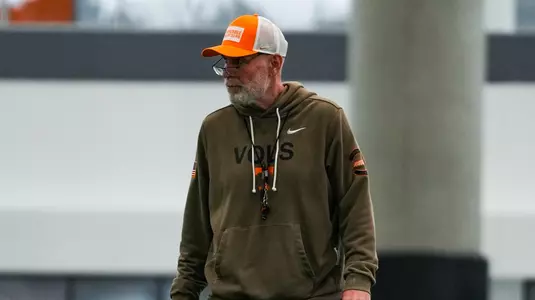
Knowles, Defense Specializing Skill Sets As Pads Come On
March 19, 2026 | Football
KNOXVILLE, Tenn. -- More three months into the defensive coordinator role at Tennessee, Jim Knowles and his defensive staff are focused on identifying the skillsets of each player as installations continued during the third spring practice for the Volunteers.
Tennessee spent two hours in shoulder pads for the first time this spring and went outdoors on Thursday. With many new faces on defense, Knowles said his scheme installation is ahead of schedule.
"I think it's progressed quickly – the install, what we've been able to teach during the winter," he said. "Nothing has been full speed, but with the staff that I was able to bring and having a few players that have been with me before, I think that the install is really ahead of schedule. Today was the first day we get to see anything full speed, so the individual player evaluation is still a long way away, but I'm happy with the progress we've made so far."
Knowles' experience has translated to into how he is evaluating his new team.
"Between starting at Duke and really to the Big 12, where I had to learn to adjust and change based on your players, but also based on what the league is like and what you're going to face," Knowles said. "A lot of guys get in trouble, I think, as coaches, as you get older in your career when you just say, well this is the way I'm going to do it, and everybody's going to do it this way. This is what I know. That constant learning process – the individual, also what you're facing, that's when it really started to change for me and kind of clicked, you know?"
One of the players who joined Knowles from Penn State is senior linebacker Amare Campbell. Campbell was the Nittany Lions' leading tackler a year ago with 103, which ranked sixth in the Big Ten. Campbell began his career at North Carolina and brings 27 career starts to the Vols. He makes up a talented linebacker room that includes returning captains Arion Carter and Jeremiah Telander.
"Amare Campbell was the quarterback of the defense for us last year, so he knows the system inside and out," Knowles said. "He has things he has to get better at. The linebacker room is really strong. Just an example, pre-practice when we're going through some adjustments and things that we may not see against our offense, right? You have to kind of throw some things in there throughout spring that you're not seeing against the offense, because you know they're coming. We faced a situation where Amare wasn't in there. He was standing back with me, and the linebacker that was in there didn't get the check right, and Amare is like, 'Hey man, you want me to get in there and do it for him?' No, you have to let them learn, but he could see it happening and understands what the check needed to be, so that's a big advantage."
Tennessee will welcome high school and middle school coaches to campus on Friday and Saturday for the annual Coaches Clinic. The Vols will close their first week of the spring with another shoulder pads practice on Saturday.
Tennessee Football Press Conference | March 19, 2026
Defensive Coordinator Jim Knowles
On his evaluation of the first three spring practices…
"I think it's progressed quickly – the install, what we've been able to teach during the winter. Nothing has been full speed, but with the staff that I was able to bring and having a few players that have been with me before, I think that the install is really ahead of schedule. Today was the first day we get to see anything full speed, so the individual player evaluation is still a long way away, but I'm happy with the progress we've made so far."
On the individual player evaluation process…
"Most of it is individual players. I'm trying to learn the players, what they do well, what they need to work on. Obviously, when you structure a defense, in the beginning it becomes less about what I know and more about what the guys can do. So when I walk around a lot, I'm really doing those individual evaluations and trying to get to learn the players."
On his objectives and what needs to be accomplished during the spring…
"We need to put the players in as many different positions or situations so we can learn what they do best. I mean, that's the first thing. The overall installation of the scheme and the learning involved, and the teaching, that's second. You want to make sure that they understand the concepts. So learn what they can do, understand the concepts, and then it's just building that culture where the guys believe that when they take the field, that they're in control of the game. It's that building confidence that's really important."
On the differences between installing his system at Tennessee and previous programs…
"In the past, there was a lot of similarities with getting these installs done and getting things accomplished. I think it's changed a lot, with the transfer portal and the fact that here I was able to bring some coaches with me. This is different. This is different. The fact that we have coaches who already understand the system and what we like to do, and then we have a few players that have been in it, that's unique. I haven't been in that before. So, I think it gives us really a step up. I know there were some struggles last year on defense, but the year before that they were pretty good, so we're not starting at ground zero. I mean, there are players here that remain here who have experienced success, so that makes this situation different also."
On where he learned to focus on the specialized skill set of his players…
"When I was at Duke, I really began to learn how critical that was. When you're in a situation where you may not be as physically talented as your opponents, you have to really put the players in the right position so that they can succeed. I think up to that point in my career, it was a lot of this is how I do it, and this is what we're going to do. And then I started to really get into that individual, what that player does best, and how I can put him in a position to succeed. Also, with the mindset of change, right? Of being adaptable, based on the type of players that you have. Even more so when I moved to the Big 12, because at the time, everybody was taking a lot of deep shots and really throwing the ball all over the place. Between starting at Duke and really to the Big 12, where I had to learn to adjust and change based on your players, but also based on what the league is like and what you're going to face. A lot of guys get in trouble, I think, as coaches, as you get older in your career when you just say, well this is the way I'm going to do it, and everybody's going to do it this way, this is what I know. That constant learning process – the individual, also what you're facing, that's when it really started to change for me and kind of clicked, you know?"
On what Amare Campbell is doing well and how critical his leadership position is at linebacker…
"Amare Campbell was the quarterback of the defense for us last year, so he knows the system inside and out. He has things he has to get better at. You know, his tackling in open space. We've been able to study those things to start to give him an advantage to get better. It's already a strong room. The linebacker room is really strong. Just an example, pre-practice when we're going through some adjustments and things that we may not see against our offense, right? You have to kind of throw some things in there throughout spring that you're not seeing against the offense, because you know they're coming. We faced a situation where Amare wasn't in there. He was standing back with me, and the linebacker that was in there didn't get the check right, and Amare is like, 'Hey man, you want me to get in there and do it for him?' No, you have to let them learn, but he could see it happening and understands what the check needed to be, so that's a big advantage."
On becoming a better tackling team in practice…
"We do have the advantage of video, and we have Coach (John Bonamego) on special teams who has really studied it. He was able to go back to all of our current players and the players who transferred and break down all their tackles or missed tackles over the course of their career. You kind of put them into categories of how they missed, why they missed, what they did well, so you can build an individual tackling reel and teach for each player, which is really unique. We don't tackle anybody in practice, so you have to really be coaching body position, and it becomes more of a mental game. I try to teach the guys, you have to mentally tackle. Something has to click in your brain that as you go to approach that ball carrier or receiver, what's your technique going to be in this particular situation? We try to evaluate that on film, just to get them into the right body position based on where the ball is on the field. What's the support structure? Am I inside, am I outside? All those things change your leverage and how you're going to approach the tackle. It's not really a tackle, right? So you're just trying to coach fit position and talking to the player. When you're able to show them the film, break it down in position, what kind of tackle would you have used in this situation? What were you thinking? See if it clicks in their mind, because a lot of guys early on just run around. You're trying to coach the actual tackle, even though it didn't happen, more from a position and a mental standpoint."
On analyzing every career tackle for every player…
"Yes. Every career tackle for every player, and all their misses. You can put them into categories. The ones that were successful and why they were successful, the ones that weren't and why they weren't. Each guy has their own tackling reel throughout their career, so you are able to show them the different situations: where the ball was on the field, what kind of play it was, what type of tackle you used, and what you didn't use and could have done."
"Special teams, too. Coach Bonamego does a great job with that. When I came here, he had a whole tackling report along with the individual cut ups, so you can sit there and watch. We really need to use that. We didn't have quite as much a chance this year, but in the future, you need to use that in your decisions you're making on the transfer portal. Because you can watch the player on film, but when you have an individual tackling breakdown – because the job of the defense is to stop the ball, to get guys on the ground. It's really an ultimate evaluator when you are looking at transfer portal guys and guys who played, the speed of the game, how things happened, where they missed and why they missed, and make decisions on if that is something we can fix. Tackling, it's like stripping the ball. You see the guys that are naturally good. You are trying to coach that technique of stripping the ball. Some guys are just really good at it. Same thing with tackling. Really picked up at Oklahoma State, because we have a lot of wrestlers. Wrestlers get people on the ground. That wrestling, that kind of background, can help in your recruiting or your decisions also."
On if tackling in practice is ever going to be an option again…
"I don't think so. I don't think so. I mean you may have a couple of live situations. I'm sure Coach (Josh Heupel) will put us in some live tackling situations, but you don't do it that much because you are trying to save the player on both sides, offense and defense. Also, even when you're live against your own team, you're not going to cut tackle or tackle low. That can build bad habits. You see in the game, guys are going to pull the trigger, shoot the guy. Even when you are going live against your own offense, you are not going to do that. It's a difficult proposition, but something that I am glad we have adjusted to it. You know, for the health of the player. But now you have to be creative in how you teach all these things, with having these tackling breakdowns and drills, and then coaching even in a non-tackling situation, your body position. And, asking the player. You can put the film up there, what kind of tackle were you going to use right here? He says one thing was that your body is not in the right position to use that tackle. So, I think that is the best you can do. It's good for the game. It makes it more difficult, but as coaches we have to adjust to that."
Tennessee spent two hours in shoulder pads for the first time this spring and went outdoors on Thursday. With many new faces on defense, Knowles said his scheme installation is ahead of schedule.
"I think it's progressed quickly – the install, what we've been able to teach during the winter," he said. "Nothing has been full speed, but with the staff that I was able to bring and having a few players that have been with me before, I think that the install is really ahead of schedule. Today was the first day we get to see anything full speed, so the individual player evaluation is still a long way away, but I'm happy with the progress we've made so far."
Knowles' experience has translated to into how he is evaluating his new team.
"Between starting at Duke and really to the Big 12, where I had to learn to adjust and change based on your players, but also based on what the league is like and what you're going to face," Knowles said. "A lot of guys get in trouble, I think, as coaches, as you get older in your career when you just say, well this is the way I'm going to do it, and everybody's going to do it this way. This is what I know. That constant learning process – the individual, also what you're facing, that's when it really started to change for me and kind of clicked, you know?"
One of the players who joined Knowles from Penn State is senior linebacker Amare Campbell. Campbell was the Nittany Lions' leading tackler a year ago with 103, which ranked sixth in the Big Ten. Campbell began his career at North Carolina and brings 27 career starts to the Vols. He makes up a talented linebacker room that includes returning captains Arion Carter and Jeremiah Telander.
"Amare Campbell was the quarterback of the defense for us last year, so he knows the system inside and out," Knowles said. "He has things he has to get better at. The linebacker room is really strong. Just an example, pre-practice when we're going through some adjustments and things that we may not see against our offense, right? You have to kind of throw some things in there throughout spring that you're not seeing against the offense, because you know they're coming. We faced a situation where Amare wasn't in there. He was standing back with me, and the linebacker that was in there didn't get the check right, and Amare is like, 'Hey man, you want me to get in there and do it for him?' No, you have to let them learn, but he could see it happening and understands what the check needed to be, so that's a big advantage."
Tennessee will welcome high school and middle school coaches to campus on Friday and Saturday for the annual Coaches Clinic. The Vols will close their first week of the spring with another shoulder pads practice on Saturday.
Tennessee Football Press Conference | March 19, 2026
Defensive Coordinator Jim Knowles
On his evaluation of the first three spring practices…
"I think it's progressed quickly – the install, what we've been able to teach during the winter. Nothing has been full speed, but with the staff that I was able to bring and having a few players that have been with me before, I think that the install is really ahead of schedule. Today was the first day we get to see anything full speed, so the individual player evaluation is still a long way away, but I'm happy with the progress we've made so far."
On the individual player evaluation process…
"Most of it is individual players. I'm trying to learn the players, what they do well, what they need to work on. Obviously, when you structure a defense, in the beginning it becomes less about what I know and more about what the guys can do. So when I walk around a lot, I'm really doing those individual evaluations and trying to get to learn the players."
On his objectives and what needs to be accomplished during the spring…
"We need to put the players in as many different positions or situations so we can learn what they do best. I mean, that's the first thing. The overall installation of the scheme and the learning involved, and the teaching, that's second. You want to make sure that they understand the concepts. So learn what they can do, understand the concepts, and then it's just building that culture where the guys believe that when they take the field, that they're in control of the game. It's that building confidence that's really important."
On the differences between installing his system at Tennessee and previous programs…
"In the past, there was a lot of similarities with getting these installs done and getting things accomplished. I think it's changed a lot, with the transfer portal and the fact that here I was able to bring some coaches with me. This is different. This is different. The fact that we have coaches who already understand the system and what we like to do, and then we have a few players that have been in it, that's unique. I haven't been in that before. So, I think it gives us really a step up. I know there were some struggles last year on defense, but the year before that they were pretty good, so we're not starting at ground zero. I mean, there are players here that remain here who have experienced success, so that makes this situation different also."
On where he learned to focus on the specialized skill set of his players…
"When I was at Duke, I really began to learn how critical that was. When you're in a situation where you may not be as physically talented as your opponents, you have to really put the players in the right position so that they can succeed. I think up to that point in my career, it was a lot of this is how I do it, and this is what we're going to do. And then I started to really get into that individual, what that player does best, and how I can put him in a position to succeed. Also, with the mindset of change, right? Of being adaptable, based on the type of players that you have. Even more so when I moved to the Big 12, because at the time, everybody was taking a lot of deep shots and really throwing the ball all over the place. Between starting at Duke and really to the Big 12, where I had to learn to adjust and change based on your players, but also based on what the league is like and what you're going to face. A lot of guys get in trouble, I think, as coaches, as you get older in your career when you just say, well this is the way I'm going to do it, and everybody's going to do it this way, this is what I know. That constant learning process – the individual, also what you're facing, that's when it really started to change for me and kind of clicked, you know?"
On what Amare Campbell is doing well and how critical his leadership position is at linebacker…
"Amare Campbell was the quarterback of the defense for us last year, so he knows the system inside and out. He has things he has to get better at. You know, his tackling in open space. We've been able to study those things to start to give him an advantage to get better. It's already a strong room. The linebacker room is really strong. Just an example, pre-practice when we're going through some adjustments and things that we may not see against our offense, right? You have to kind of throw some things in there throughout spring that you're not seeing against the offense, because you know they're coming. We faced a situation where Amare wasn't in there. He was standing back with me, and the linebacker that was in there didn't get the check right, and Amare is like, 'Hey man, you want me to get in there and do it for him?' No, you have to let them learn, but he could see it happening and understands what the check needed to be, so that's a big advantage."
On becoming a better tackling team in practice…
"We do have the advantage of video, and we have Coach (John Bonamego) on special teams who has really studied it. He was able to go back to all of our current players and the players who transferred and break down all their tackles or missed tackles over the course of their career. You kind of put them into categories of how they missed, why they missed, what they did well, so you can build an individual tackling reel and teach for each player, which is really unique. We don't tackle anybody in practice, so you have to really be coaching body position, and it becomes more of a mental game. I try to teach the guys, you have to mentally tackle. Something has to click in your brain that as you go to approach that ball carrier or receiver, what's your technique going to be in this particular situation? We try to evaluate that on film, just to get them into the right body position based on where the ball is on the field. What's the support structure? Am I inside, am I outside? All those things change your leverage and how you're going to approach the tackle. It's not really a tackle, right? So you're just trying to coach fit position and talking to the player. When you're able to show them the film, break it down in position, what kind of tackle would you have used in this situation? What were you thinking? See if it clicks in their mind, because a lot of guys early on just run around. You're trying to coach the actual tackle, even though it didn't happen, more from a position and a mental standpoint."
On analyzing every career tackle for every player…
"Yes. Every career tackle for every player, and all their misses. You can put them into categories. The ones that were successful and why they were successful, the ones that weren't and why they weren't. Each guy has their own tackling reel throughout their career, so you are able to show them the different situations: where the ball was on the field, what kind of play it was, what type of tackle you used, and what you didn't use and could have done."
"Special teams, too. Coach Bonamego does a great job with that. When I came here, he had a whole tackling report along with the individual cut ups, so you can sit there and watch. We really need to use that. We didn't have quite as much a chance this year, but in the future, you need to use that in your decisions you're making on the transfer portal. Because you can watch the player on film, but when you have an individual tackling breakdown – because the job of the defense is to stop the ball, to get guys on the ground. It's really an ultimate evaluator when you are looking at transfer portal guys and guys who played, the speed of the game, how things happened, where they missed and why they missed, and make decisions on if that is something we can fix. Tackling, it's like stripping the ball. You see the guys that are naturally good. You are trying to coach that technique of stripping the ball. Some guys are just really good at it. Same thing with tackling. Really picked up at Oklahoma State, because we have a lot of wrestlers. Wrestlers get people on the ground. That wrestling, that kind of background, can help in your recruiting or your decisions also."
On if tackling in practice is ever going to be an option again…
"I don't think so. I don't think so. I mean you may have a couple of live situations. I'm sure Coach (Josh Heupel) will put us in some live tackling situations, but you don't do it that much because you are trying to save the player on both sides, offense and defense. Also, even when you're live against your own team, you're not going to cut tackle or tackle low. That can build bad habits. You see in the game, guys are going to pull the trigger, shoot the guy. Even when you are going live against your own offense, you are not going to do that. It's a difficult proposition, but something that I am glad we have adjusted to it. You know, for the health of the player. But now you have to be creative in how you teach all these things, with having these tackling breakdowns and drills, and then coaching even in a non-tackling situation, your body position. And, asking the player. You can put the film up there, what kind of tackle were you going to use right here? He says one thing was that your body is not in the right position to use that tackle. So, I think that is the best you can do. It's good for the game. It makes it more difficult, but as coaches we have to adjust to that."

Players Mentioned


FB | Edwin Spillman Orange & White Press Conference (4.11.26)
Saturday, April 11
FB | Faizon Brandon, George MacIntyre, Braylon Staley & Ryan Staub Orange & White Press Conference (4.11.26)
Saturday, April 11
FB | Jeremiah Telander Orange & White Press Conference (4.11.26)
Saturday, April 11
FB | Josh Heupel Orange & White Press Conference (4.11.26)
Saturday, April 11